During our first day at Yad Vashem, we were taken on a tour of Israel by Ephraim (one of the Gandel organisers), so that we could understand the geopolitics as well as geography of the land where we will be spending the next three weeks.
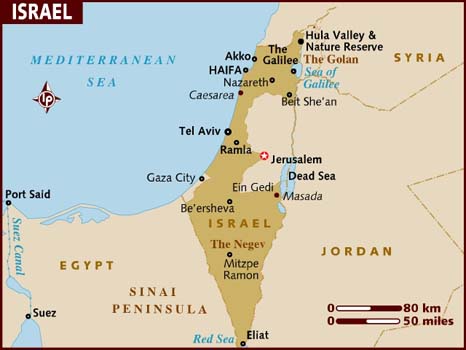
You can see from the map above that Israel is a very small country (21,937 sq km). With a large range of cultures and religions interacting with one another, and due to the size of the country, people are forced to live side by side. This means that in a 10 km radius, you might pass by a Palestinian settlement, a Jewish Settlement and within that, Ultra-Orthodox Jewish communities. Further to this, when walking through Jerusalem (the Capital), people walk and live alongside each other.
For further contextual information, I’ve taken the below extract from CIA, the World Fact Book, to give a deeper overview of Israel.
The State of Israel was declared in 1948, after Britain withdrew from its mandate of Palestine. The UN proposed partitioning the area into Arab and Jewish states, and Arab armies that rejected the UN plan were defeated. Israel was admitted as a member of the UN in 1949 and saw rapid population growth, primarily due to migration from Europe and the Middle East, over the following years. Israel fought wars against its Arab neighbors in 1967 and 1973, followed by peace treaties with Egypt in 1979 and Jordan in 1994.
Israel took control of the West Bank and Gaza Strip in the 1967 war, and subsequently administered those territories through military authorities. Israel and Palestinian officials signed a number of interim agreements in the 1990s that created an interim period of Palestinian self-rule in the West Bank and Gaza. Israel withdrew from Gaza in 2005. (Source: CIA, World Fact Book)
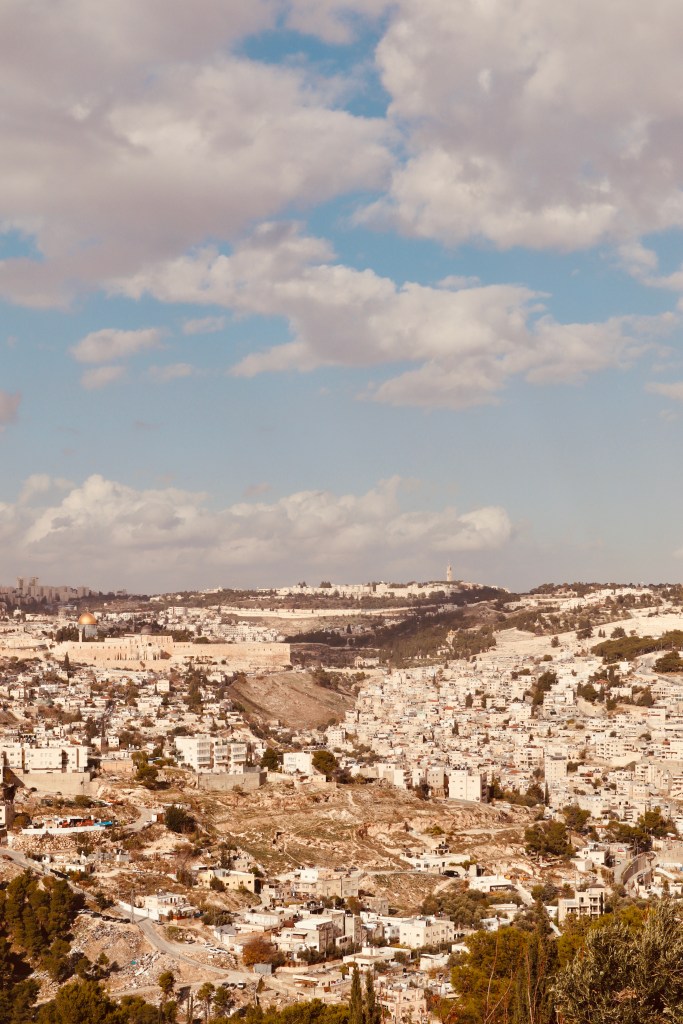
FACT FILE ON ISRAEL
Population
8.4 million
(July 2018 est.)
Ethnicity
Jewish 74.4%
(of which Israel-born 76.9%, Europe/America/Oceania-born 15.9%, Africa-born 4.6%, Asia-born 2.6%), Arab 20.9%, other 4.7% (2018 est.)
Language
Hebrew (official), Arabic (used officially for Arab minority), English (most commonly used foreign language)
Religion
Jewish 74.7%, Muslim 17.7%, Christian 2%, Druze 1.6%, other 4% (2016 est.)
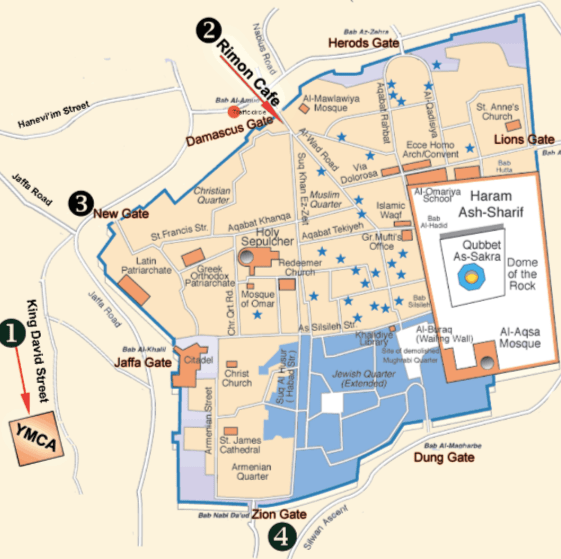
On my third night in Jerusalem, we went for a walk around Jerusalem to chase the sunset and see some of the famous sites. We entered via the Jaffa gate (see map below), which walked us through part of the Armenian Quarter. We found ourselves wandering through markets filled with pomegranates, beautiful scarves, spices, rugs, candle holders, amongst a few things.
When then entered the Jewish Quarter, and a few minutes later we had to place our bags through a security check.
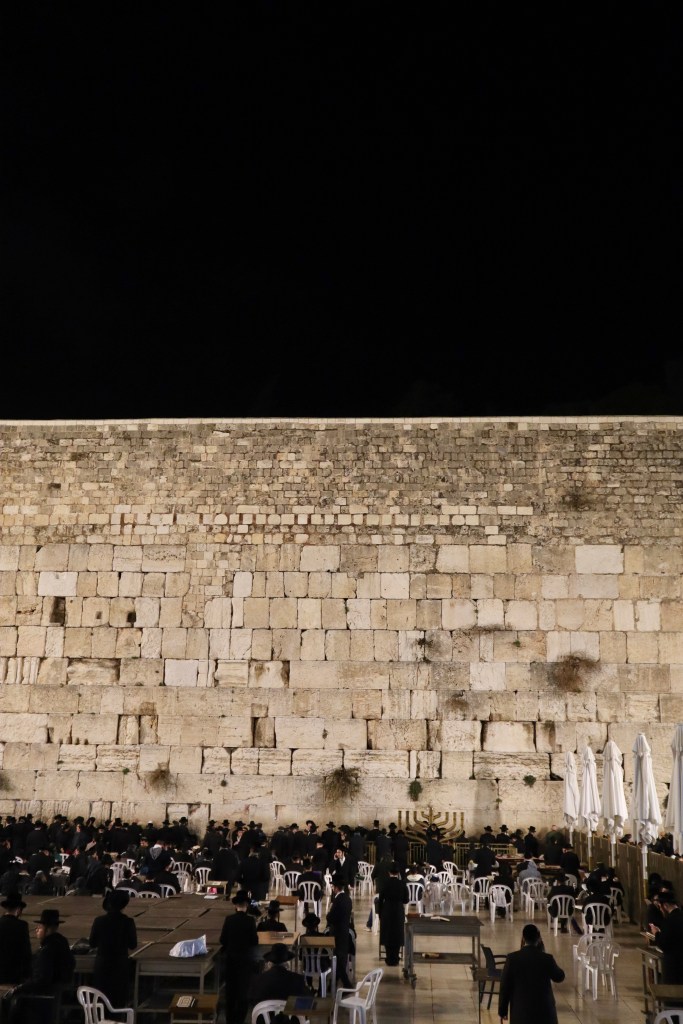
All of a sudden I was face to face with the Western Wall (see image above). As it was the last day of Hanukah, the space was packed with people. I felt a huge rush of emotion as I watched worshippers recite scriptures, lay their hands on 2000-year-old stone and utter impassioned appeals. I quickly noticed a divide between men and women, and many families gathering to prayer. We washed our hands and entered the female side, observing a powerful display of devout Jewish people. Women would read scriptures and then walk to the wall to pray, laying hands on the wall. They would then walk backwards away from the wall as they consider it disrespectful to turn their back on something so holy. As a Christian, I felt an overwhelming feeling (which I am still trying to process).
For those who don’t know, the Western Wall is one of the most holy sites in Israel. I’ll let Lonely Planet give an explanation below of its significance:
Following the destruction of the Temple in 70 CE, Jews were sent into exile and the Temple’s precise location was lost. Upon the Jews’ return, they purposely avoided Temple Mount, fearing that they might step on the Holy of Holies: the ancient inner sanctum of the Temple, barred to all except the high priest. Instead they began praying at this remaining element of the original structure.
The Wall became a place of pilgrimage during the Ottoman period, and Jews would come to mourn and lament the destruction of the Temple – that’s why the site is also known as the Wailing Wall, a name that Jews tend to avoid. At this time, houses were pressed right up to it, leaving just a narrow alley for prayer.
In 1948, Jews lost access to the Wall when the Old City was taken by the Jordanians, and the population of the Jewish Quarter was expelled. Nineteen years later, when Israeli paratroopers stormed in during the Six-Day War, they fought their way directly here and their first action on securing the Old City was to bulldoze the neighbouring Arab houses to create the sloping plaza that exists today.
 History and Memory in the Holy Land