Today was the most incredible day of learning, growing and reflecting.
We began our day with our first class at Yad Vashem (Israel’s official memorial to the victims of the Holocaust), which is a 4km drive from our hotel. We learnt about two crucial topics today – Judaism and Yad Vashem’s teaching pedagogy. It was so interesting to ground our understanding in the roots and foundations of what Jewish people believe and how this has shaped their historical experiences. We were reminded of how Judaism was ruptured due to intense antisemitism (pre and post the Holocaust), and how tirelessly Jewish people worked to make it whole again.
We then heard about the educational philosophy of Yad Vashem (the museum here in Jerusalem) from Shulamit Imber. This fiery and passionate woman shared about the power of ‘rescuing the individual out of the pile of bodies.’ She encouraged us to help our students find meaning in stories by giving individuals an identity before they became a victim in the Holocaust. She also encouraged us to ask not: “How did 100, 000 Jewish people die in the Vilna Ghetto?” but “How did 400, 000 Jewish people survive?” What did people do to survive, and what choices were they forced to make throughout?
In doing so, she shared a powerful moral dilemma and explained how we can use the ghettos of Europe in our teaching to help do this. The story is outlined below (Source: Shulamit Imber, ‘Educational Philosophy in Teaching the Holocaust.’)
In the winter of 1942 in the Vilna ghetto in Lithuania, Dr. Avraham Weinreb, faced a difficult dilemma. He assembled a group of people to consider the options. He called to the meeting a fellow doctor, a member of the Jewish leadership of the ghetto, a rabbi and a judge. People in the ghetto were ill with tuberculosis and at the time the belief was that calcium was a remedy.
Dr. Weinreb had only a limited amount of medicine, yet many people were suffering from the illness. Therefore, the question was how to allocate the medicine. If he distributed equal amounts of the calcium to everyone, it would run out quickly and all of the patients would deteriorate. However, if he distributed the calcium to only those who were slightly ill or had a better chance of recovery there was a greater chance that with the additional dosages of medicine they would survive until the liberation.
Those present at the meeting responded in various ways. The rabbi advised that only God may determine who should live and who should die. The judge noted that one may condemn to death only those who have committed a wrongdoing and therefore, refused to make a decision of this nature that would, in effect, result in a death sentence for those who were ill. Dr. Weinreb decided to distribute the calcium equally. Ultimately, when the calcium ran out, the entire group of sick people died. A few months later, a similar problem arose with a lack of insulin for diabetic patients. Again, Dr. Weinreb assembled the group of advisors and the same arguments were raised. This time however, he decided to give out the insulin only to those who had a better chance of recovery.
Dr. Weinreb wrote in his memoirs:
The lesson is important: those who maintained the right not to get involved won […]. I understood then that in the conditions of the ghettos, where lives are destined to end at any moment, there is no way of achieving a positive outcome unless one withdraws from society, and then to find oneself among those who are immoral. Anyone wishing to get involved finds himself constantly between a rock and a hard place, and has no ability to choose between right and wrong. He can only choose the lesser of two evils […] but whoever resigns from his duty because he can’t conduct himself morally, sins by choosing to avoid responsibility in my opinion, and one does not always have the privilege to resign in order to avoid the trap and remain morally pure and unblemished.
Using moral dilemmas, such as the one outlined above, can help students to see the individual, not as a victim, but as someone who lived and was forced to make choiceless choices in chaos. You can see the ghetto below – conditions were inhumane and Jewish people were left without hope.
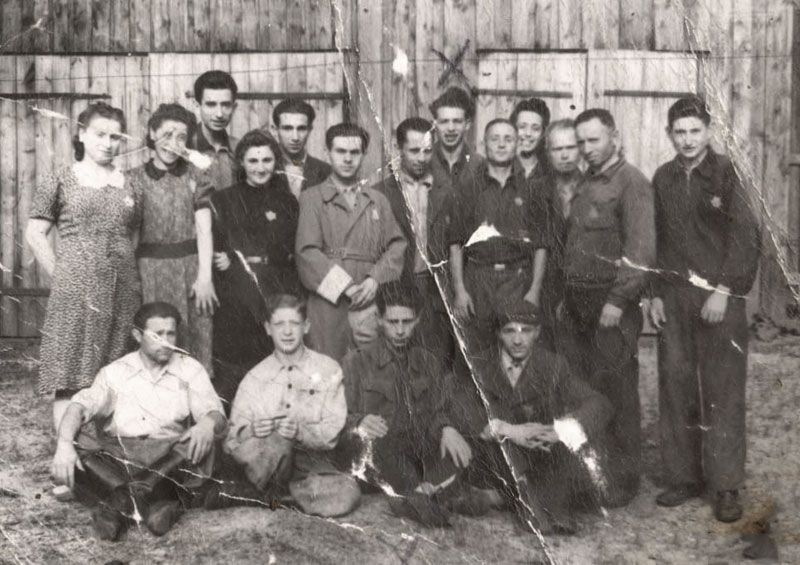
While we must teach the trauma of the Holocaust, we must ensure students enter this history safely, and come out safely on the other side too. Using moral dilemmas is one way to ‘rescue the individual out of the pile of bodies’ because it helps students to appreciate and understand Jewish life and what was ruptured as a result of the Holocaust.
 History and Memory in the Holy Land